


The operating profit margin of Australia’s container stevedoring industry increased to 24.9 per cent in 2022-23, according to the Australian Competition and Consumer Commission (ACCC).
According to the watchdog’s latest Container Stevedoring Monitoring Report 2022-23, this continues a trend of rising profit margins in the industry since a low of 5.8% in 2018-19.
Stevedores are people or companies that load and unload vessels in a port. The vast majority of fashion sold in Australia is imported from overseas, mostly via shipping containers.
While the industry profits have rapidly increased in the past few years, the ACCC believes it is too soon to know whether the current profit margins are likely to be sustained.
The ACCC is currently considering what further analysis it could undertake of the stevedores’ high profit margins of recent years.
Stevedoring is a capital-intensive business and the large investments they make are not steady or uniform, ACCC noted, so the industry’s financial performance does need to be considered over a longer timeframe.
The stevedores recorded historically low profit margins before the COVID-19 pandemic, and the industry’s average operating profit margin between 2012-13 and 2022-23 is 16%.
“While we have not formed a conclusive view on the stevedores’ profit margins, we are concerned by emerging evidence that the two new entrants of the last decade, Hutchison and VICT, are not constraining the incumbent multi-port stevedores as effectively as we had hoped,” ACCC Commissioner Anna Brakey said.
“Due to their focus on efficiency and cost minimisation, at least some shipping lines appear to be preferencing the same stevedore across multiple ports, which advantages Patrick and DP World.”
Patrick and DP World operate at Melbourne, Sydney, Brisbane and Fremantle ports. Hutchison (Sydney and Brisbane) and Victoria International Container Terminal (Melbourne) may be less attractive to shipping lines as they do not have a national presence, the report explains.
“Australia is a trade-exposed country and many of the goods that we rely on in our everyday lives come through our container ports,” Brakey said.

Source: ACCC analysis of information received from stevedores as part of the monitoring regime.
Supply chain recovery
The report also revealed that the container freight supply chain operated more predictably in 2022-23, after two years of major pandemic-induced disruption.
Global vessel schedule reliability increased from 39.9% in June 2022 to 64.2% in June 2023. However, vessel schedule reliability is still worse than it was before the pandemic, and the ACCC understands that Australia may lag the global average.
Industry participants have told the ACCC that some shipping lines have restructured their Australian services to visit fewer ports and minimise the impact of potential delays.
“We think it’s likely that delays, lower container volumes, higher shipping costs and lower freight rates have all contributed to the decision by some shipping lines to streamline their Australian services,” Brakey said.
While Australian freight rates have largely returned to their pre-pandemic levels by June 2023, the ACCC believes that at least some exporters have been paying higher rates due to the shortage of food-grade refrigerated containers.
Vessel on-time arrivals have improved significantly since 2021, and average delays have fallen significantly since late 2021.
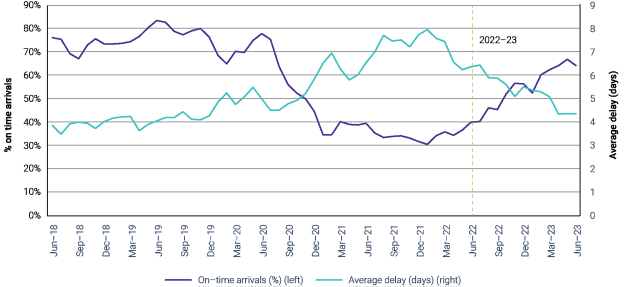
Source: Sea-Intelligence, ‘Global Liner Performance Report’, Issue 144, Sea-Intelligence, 2023. The data covers 34 trade lanes, including Asia-Oceania.
According to the ACCC, several key reforms are needed to improve the efficiency of the container freight supply chain, despite the considerable improvements over the last two years.
The watchdog said importers and exporters cannot currently access some of the key information they need to make business decisions, including how stevedore and empty container park fees will change over time. As such, the ACCC supports making it easier for cargo owners to determine all costs related to shipping lines’ services, including those charged by stevedores and empty container park operators.
The report also pushed the ACCC’s view that importers and exporters need more protection against unreasonable detention fees. Shipping lines charge detention fees for continuing to use containers beyond an agreed period. These fees become unreasonable in circumstances where importers and exporters cannot return containers on time due to factors outside their control.
The ACCC also supports the Productivity Commission’s recommendation that Part X of the Competition and Consumer Act be repealed and replaced with a more targeted exemption for shipping lines.